People Are Flocking to Cities Again

Americans relocated less during the coronavirus outbreak, moving from ane residence to some other in 2020 at the lowest rate since the government began reporting information more than than seventy years agone. And though a declining share of Americans say they want to alive in cities, fewer people moved out of them terminal year than in the period before the COVID-19 pandemic began.

Merely 8% of Americans – 26.5 million people – moved from one U.S. home to another between March 2020 and March 2021, according to data from the Census Agency's Electric current Population Survey. The 2020 charge per unit and number were the lowest since the federal government began reporting data in 1948.
The turn down in U.S. domestic migration had an impact on all types of communities – cities, suburbs and rural areas, co-ordinate to a Pew Research Heart analysis that compared data for movers in 2020 with data for movers in 2016-2018. (The data from the three-year period is based on an average of those years; 2019 migration numbers were not included because of pandemic-related data collection bug. Read the "How we did this" box for more details.)
Pew Research Center conducted this analysis to examine migration patterns during the COVID-19 pandemic, using Census Bureau data to reveal patterns and trends in U.S. geographic mobility during 2020.
The migration information is derived from the Annual Social and Economic Supplement (ASEC) of the Electric current Population Survey (CPS), which is conducted in March of every year. Administered jointly by the U.Due south. Census Agency and the Bureau of Labor Statistics, the CPS is a monthly survey of approximately 70,000 households and is the source of the nation's official statistics on unemployment. The ASEC survey in March typically features a larger sample size.
The one-twelvemonth migration data is based on respondents' answers every bit to whether they lived at the same house or apartment 1 year earlier (specifically March one of the preceding twelvemonth). Respondents answering "same firm" or not-movers include both those who did not move and those who had moved but then returned to their before residence. Domestic migrants are respondents who answered that they resided in a different firm in the United states one year earlier. Community types are divers this way: "Cities" are principal cities of metropolitan areas, "suburbs" are the balance of metropolitan areas and "rural" communities are non-metropolitan.
Each autumn, the Census Bureau publishes detailed migration tables based on the ASEC collected in March. The government has published statistics nigh this measure of migration going back to 1948, using information describing motion in the previous year. In comparing the 2021 ASEC (describing the year 2020) with those of 2017-2019 (describing the years 2016-2018), we used the boilerplate of the 3 years because that provides a more than reliable trend than a single year of data.
The onset of the COVID-19 pandemic impacted the information drove for the 2020 ASEC. The response rate for the March 2020 survey was nearly 10 per centum points lower than in preceding months. Using administrative data, Census Bureau researchers have shown that nonresponding households were less similar to respondents than in earlier years.
Hither are the questions used for this written report, along with responses.
The pandemic year of 2020 continued the same pre-pandemic pattern of net migration proceeds or loss for cities and suburban areas. More people moved out of U.S. cities than moved into them, while suburbs had more than people moving in from other U.S. communities than out. The internet flow for rural areas did not indicate strong movement in either direction in 2016-2018, while more people moved out of rural areas than moved into them in 2020.
In 2020, fewer people moved out of cities than in the pre-pandemic years, according to the census information. Overall, 4.9 million Americans left cities for suburbs or rural areas, compared with an annual boilerplate of 5.iv one thousand thousand who did and then before the pandemic. An additional 2.9 million moved into cities from suburbs or rural areas in 2020, compared with an annual average of 3.1 million for 2016-2018.
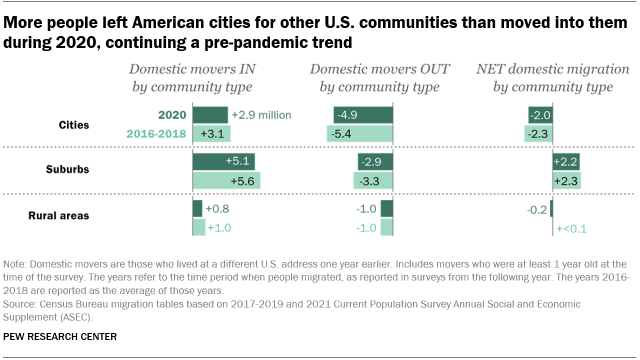
There also was no significant uptick in net migration to suburban areas in 2020, countering the pandemic narrative that people fled crowded cities for roomier communities. From March 2020 to March 2021, 5.1 million Americans moved into suburban areas from other types of communities, compared with 5.6 million who did and then on average each yr from 2016 to 2018. Moves out of suburbs also went downward: 2.9 one thousand thousand Americans left for other types of communities in 2020, compared with an average 3.3 meg in the three years before the pandemic began.
For rural areas, the number of people leaving for other U.South. communities did not change in 2020 compared with the average of 2016 to 2018, remaining nigh 1 million. Just fewer people moved into rural places from other types of communities in 2020 than in the pre-pandemic years – about 800,000 – compared with an almanac average of 1 million prior to the pandemic.
In 2020, 15.8 1000000 of the 26.5 million domestic moves were inside the same county. Moves involving a alter in community type — betwixt urban center, suburban or rural areas — numbered 8.8 million.
These numbers do not account for other factors that cause populations to ascension or autumn. They do non include immigrants moving from abroad, whose numbers also declined during the pandemic. They also do not include the impact of births and deaths.
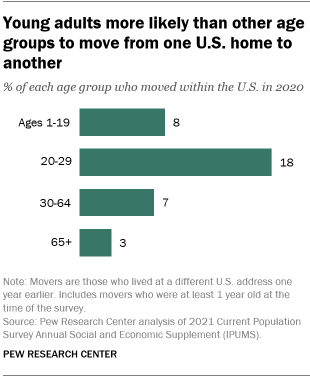
Young adults, ages 20 to 29, take been the most likely to move, and that remained true in 2020 – 18% of them did, compared with rates of less than 10% for those ages i to 19, adults ages xxx to 64 and those ages 65 and older. However, the migration rate of young adults declined in 2020, as did the overall migration rate.
Regarding migration out of cities, other recent analysis has found that at that place was stepped-up migration out of New York and San Francisco, simply that otherwise, migration patterns did not change much from before 2020 when the pandemic began.
To be sure, migration data doesn't provide a full pic of people'due south preferences about where they desire to live. Some may wish to leave the urban center, particularly in light of the pandemic, but may not be able to. A new Pew Research Center survey finds that Americans are less likely than before the pandemic to want to live in cities – about one-in-five say this at present, compared with roughly one-in-four in 2018. These shares include people who live in cities and exercise not want to move out of the city, besides equally those who live in suburbs or rural areas and say they would desire to move to a city.
The survey, conducted in Oct 2021, likewise constitute that many pandemic movers relocated simply temporarily. Well-nigh a quarter of Americans who said they had moved due to the pandemic since early 2020 (23%) now say they live in the same home they had occupied earlier. This is not statistically different from the 31% who said so in a survey late last year. An analysis of U.S. Postal Service data for New York Metropolis found that about early pandemic moves were temporary.
Both surveys, taken in November 2020 and October 2021, found that immature adults are more likely than older ones to have moved due to the pandemic, including 13% of 18- to 29-year-olds in the nearly contempo survey. And in both surveys, Americans who moved for reasons related to the pandemic (26% in the 2021 survey) are more than likely than those who moved for other reasons (12% in the 2021 survey) to say the move had a negative touch on on their lives.

Richard Fry is a senior researcher focusing on economics and education at Pew Research Middle.

D'Vera Cohn is a senior author/editor focusing on clearing and demographics at Pew Research Center.
Source: https://www.pewresearch.org/fact-tank/2021/12/16/in-2020-fewer-americans-moved-exodus-from-cities-slowed/
0 Response to "People Are Flocking to Cities Again"
Post a Comment